
By Dr Gwen Egginton
“To forget how to dig the earth and to tend the soil is to forget ourselves” – Mahatma Gandhi
I’ve been hosting WWOOFers for around 40 years now – right from when WWOOF stood for Working Weekends on Organic Farms – but the journey started earlier than that. I first studied for a degree in Chemical Physics and didn’t really like where it was taking me so decided to spend some time as a volunteer teacher with VSO (Voluntary Service Overseas) and was lucky enough to end up in Tanzania, East Africa for three years. I had a great time, Tanzania just after independence was in a Socialist phase and one of the really enlightened policies was that everyone should be growing as much of their own food as possible. In our girl’s boarding school that meant a lot of time working on the school farm and I soon discovered I really loved working with the students and it was more fun than chemistry. Then they included some soil science in the A-level syllabus so I had to learn some, and on the road to Moshi on my motor bike I saw the light – I needed to study Soil Science! So I spent a year doing a Masters and then found myself teaching at Edinburgh University and researching for a PhD.
That’s where I realised the contradictions – we were teaching our students what an amazing resource the soil was, how that thin layer of living soil was all that sustained all of us, how the soil was a living ecosystem recycling all the plant nutrients, stabilising the soil against erosion, providing resilience against changing weather, feeding the plants. Then we told them to ignore all of that in agricultural practice: feed the plants on chemical nutrients, use chemicals that destroy the life in the soil – all to maximise yield. So when I looked into the alternatives and discovered organics, the more I learned about it the more it made complete sense. Nurture the soil and the crops will be healthy, healthy crops will keep humans and animals healthy. Conventional agriculture sets us apart from nature in a battle against nature fought with an arsenal of chemicals. Organics seeks to work with nature acknowledging that we are ourselves a part of nature. Needless to say, back in the 70’s such views didn’t make me very popular, and being a woman didn’t help. After Edinburgh I managed to buy a place with land and continued teaching for a while but, at the end of that job, was quite happy to concentrate on growing and learning hands- on about organic growing. So that got me hooked and I’ve been growing ever since.
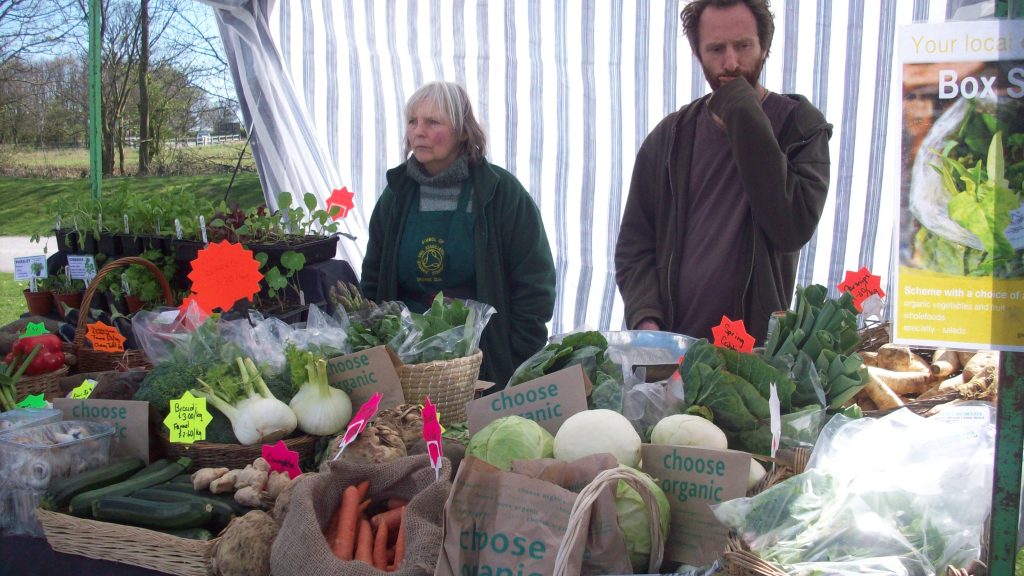
That idea that we do not need to be in a battle against nature, that we can live in a way in which everything benefits, to me extends to our relationships with each other. You could call it mutuality. It runs counter to our prevailing way of looking at things in western culture but even in business is it not possible that we can benefit each other and be fair to each other? The whole idea of WWOOF fits so much into this idea for me, and having already spent some years sharing my home with random people it wasn’t such a new idea! I love the fact that no money is changing hands, but we are all benefiting from the exchange. It’s hard to put into words how much hosting WWOOFers has enriched my life and how many amazing people I have met from all over the world. I never cease to be amazed at the range of reasons people have for WWOOFing – and it really is such a precious aspect of the organisation. People come for travel, to meet like minded people, to learn about growing of course, for respite from a tough world, to recover from life’s stresses, to spend time outdoors, even as one memorable volunteer said that “barking in my garden would be good for her” (probably a google translation of wwoof), or an access weekend with children! Not always easy of course – French students here to learn English who didn’t want to talk, the odd drunk, a few lacking in work ethic, some who were dangerous to plants, a suspected spy lying low, (my overactive imagination!) but totally made up for by all the talking and sharing and learning that happens in most WWOOF exchanges!
You never stop learning in gardening! Not just about the crops and the weeds but all the other life in the ground. Global warming and the degradation of our environment are such pressing issues. Our agriculture has now taken over almost all available land so how we grow is really important. Of all the mammals in the world only 4% are wild animals, of all the birds in the world 70% are our domesticated birds. It seems to me that if we are to survive we must learn to use our land to encourage biodiversity, to benefit all of wildlife, as well as growing our food and that’s what I try to do here at Green Growers. Of all the extra carbon dioxide in the atmosphere 10% has come from the degradation of soils in agriculture, i.e. the loss of organic matter in the soil, soil carbon. It follows that if agriculture reverses this by adopting organic and regenerative methods that 10% could go back into the soil. So here, we are trying to find ways to increase organic matter in the soil. We make a lot of compost of course but also are using composted wood chips, mulching etc. Another thing I came to realise was that as far as possible, to have a system which is sustainable, we should be operating a “closed system” i.e. not relying on inputs from elsewhere. For example I used to keep chickens for eggs, feeding them on bought in organic pellets, bedding them on bought in straw, then using the resultant manure as the basis of fertility. I came to realise that in fact I was relying on another organic farm producing the feed for the fertility of my land and that in the end that wasn’t sustainable. So now I don’t have chickens and more or less follow veganic principles (but I do make worm compost) and have very few inputs. I love growing herbs and sell a lot of potted plants as well as raising all the plants myself to grow-on so I use a lot of potting compost. This I make more or less from ingredients produced here, based on sieved composted woody material, worm compost, leaf mould and a compost I make from nettles and sedge.
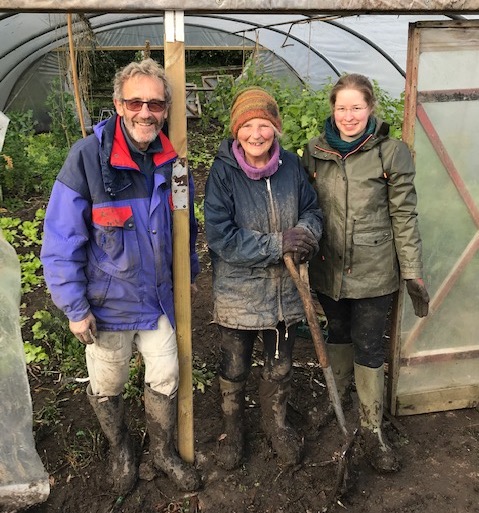
I’ve learnt also that hot compost heaps are sometimes counterproductive. If you don’t turn the heap when it gets hot the heat will kill everything except the thermophilic bacteria. I came to realise that compost is important not just to return the nutrients to the soil but also to inoculate the soil again with all the life, bacteria, fungi, protozoa etc. from the compost heap. It doesn’t kill the weed seeds of course but neither does it kill crop seeds. From a spreading of compost I can find a lot of useful plants as well as the weeds, it could be a new kind of growing just finding the things that can reseed themselves instead of all that trouble we go to!
Like so many people these days I struggle to understand the craziness and the inability of our leaders to really deal with the problems we face, in terms of justice, the environment, and global warming. For most people life exists in an unreal bubble away from the real natural world. But working the land and sharing that with others makes total sense for me – both in the well-being the work gives me, and also the sense of being part of a positive future. I feel so fortunate that I have been able to find a way of life that’s good for me, for the bit of earth I care for, for those I work with and those I supply with food.
Dr Gwen Egginton Sept. 2025
We’d like to give a massive thank you to Gwen for writing this article for us. We hope you enjoyed reading these words of wisdom and optimism written with such clarity and humour 🙂 Thank you Gwen.
Find out more about WWOOFing opportunities at Green Growers.
Disclaimer: It should be noted that hosts receive guests solely as part of an immersive learning experience, in line with WWOOF UK’s educational charitable aims. Visitors participate in the host’s lifestyle, in order to learn. There is no formalised or contractual agreement and the residential visitors (WWOOFers) are free to come and go at will, so are not considered workers. WWOOFers are absolutely not a substitute for paid labour. Any mention of the words ‘work’ or ‘exchange’ in reviews, articles and other content created by our membership is language chosen by the author and not sanctioned by WWOOF.


